

Breast Augmentation – Macrolane Ban
Macrolane hyaluronic acid is banned in France for breast augmentation due to inflammatory risks and screening difficulties.
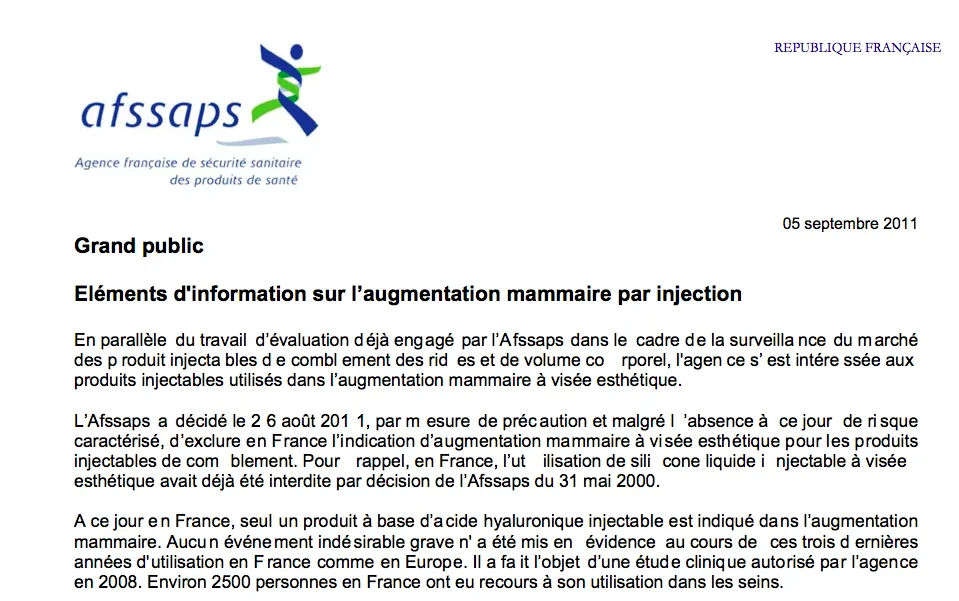
Heralded over the past three years as a breakthrough in cosmetic breast enhancement, the use of Macrolane®, a highly cross-linked hyaluronic acid gel, has now been officially banned by the French Health Products Safety Agency (AFSSAPS) for use in breast augmentation.
Why Was Macrolane Banned?
The agency cited several potential risks associated with the use of Macrolane for breast enlargement:
- Chronic inflammation of the breast due to the need for regular reinjections, approximately every 18 months
- Product migration as Macrolane is non-encapsulated and can diffuse into the surrounding tissue
- Difficulty interpreting mammograms, which compromises effective breast cancer screening
This decision effectively puts an end to a media frenzy orchestrated by Q-Med Laboratories, which marketed Macrolane as a groundbreaking alternative to traditional silicone breast implants.
A Personal Professional Stance
From the outset, I believed this product was a step backward in terms of safety. Unlike silicone implants, which are housed within a sealed shell, Macrolane lacks structural containment, leading to unpredictable results and safety concerns.For these reasons, we never used Macrolane in our practice.

À propos de l'auteur
Dr. Marc-David Benjoar
Chirurgien plasticien à Paris, spécialisé en rhinoplastie, augmentation mammaire mini-invasive et reconstruction mammaire par lambeau DIEP
4,8 / 5
Calculée sur + 400 avis patients, note globale du cabinet Plasticiens Paris
★★★★★
4,8 · +400 avis
Presse & télévision
Formation & diplômes
- Docteur en Médecine
- DESC de Chirurgie Plastique, Reconstructrice et Esthétique (seul diplôme autorisant l'exercice depuis 1986)
- Université Paris VII-Paris Cité
- Ancien interne et Chef de clinique des Hôpitaux de Paris, formé à l'Hôpital Européen Georges Pompidou auprès du Pr Lantieri
- Collège Français de Chirurgie Plastique Reconstructrice et Esthétique
- Concours de l'internat, major de promotion chirurgie Paris, médaille d'or de chirurgie des hôpitaux de Paris
- Prix Le Dentu-Renon (Académie nationale de Chirurgie), prix James Barrett Brown (AAPS)
- Master M2 de sciences chirurgicales · DIU anatomie appliquée à la chirurgie plastique · DIU chirurgie de la main · DU techniques microchirurgicales
- Inscrit à l'Ordre des médecins de Paris n° 75/77646 (RPPS 10004402102)
Engagement hospitalier et institutionnel
Ancien Chef de Clinique Assistant des Hôpitaux, praticien attaché à l'Hôpital Européen Georges Pompidou, où il a participé à 7 greffes du visage · Membre de l'équipe de chirurgiens plasticiens de l'Institut Français du Sein depuis 2015 · Enseignant au Diplôme Universitaire de techniques endoscopiques en chirurgie plastique · Associé depuis 2010 au sein du cabinet Plasticiens Paris
Spécialités
Read also
Beware of “fake injectors”
Learn how to recognize fake injectors, avoid serious risks, and choose a qualified doctor for your cosmetic injections.
Nymphoplasty Reimbursement: How Much Is Covered for Labioplasty?
Find out about the conditions for reimbursement of labiaplasty by Social Security and mutual insurance companies. Expert opinions from Dr. Benjoar and Dr. Berdah.